Introduction
The evolution of residential architecture has seen a significant shift towards structures that offer both expansive utility and residential comfort. Among the most prominent trends in this sector is the rise of the barndominium. While originally conceived as utilitarian storage spaces converted for living, modern iterations are sophisticated dwellings. For growing families or those seeking ample guest accommodations, 4 bedroom barndominium floor plans represent the pinnacle of this architectural movement. These plans offer a unique canvas where the rustic charm of a barn meets the modern luxury of a custom home, with the living room often serving as the vibrant heart of the design.
Designing a floor plan that accommodates four bedrooms while maintaining an open, airy atmosphere requires strategic planning. Unlike traditional stick-built homes where walls define every space, barndominiums utilize the strength of post-frame construction to create vast, unobstructed interiors. This structural advantage allows for a central living area that feels significantly larger than its square footage might suggest. However, the challenge lies in balancing this openness with the privacy and accessibility required for multiple bedrooms.
This article provides a deep dive into the intricacies of designing and selecting the perfect layout. We will explore how to maximize the potential of the great room, the strategic placement of bedrooms for privacy, and the essential considerations that make 4 bedroom barndominium floor plans a superior choice for modern living.
Table of Contents
- The Anatomy of Barndominium Architecture
- Centering the Design: The Great Room Concept
- Strategic Bedroom Placement and Zoning
- Layout Variations for 4 Bedrooms
- Flow and Traffic Patterns in Open Spaces
- Materiality and Aesthetic Integration
- Cost Efficiency and Structural Benefits
- Customization and Future-Proofing
- Frequently Asked Questions
- Conclusion
The Anatomy of Barndominium Architecture
To fully appreciate the utility of these floor plans, one must understand the structural methodology. Barndominiums are typically constructed using post-frame engineering. This method utilizes large vertical posts or laminated columns buried deep into the ground or mounted on a concrete foundation. These posts support the roof trusses, transferring the load directly to the ground rather than relying on interior load-bearing walls.
This engineering reality has profound implications for 4 bedroom barndominium floor plans. It means that the interior layout is entirely flexible. A designer can place walls anywhere within the shell without needing to account for support beams or columns interrupting the flow. This freedom is most visibly expressed in the living room area, which can span the entire width of the structure if desired, creating a “clear span” environment that is impossible to achieve cheaply in traditional construction.
The Shell and Divide Strategy
Industry trends suggest that most barndominium floor plans follow a “shell and divide” logic. The exterior shell is erected first, creating a weather-tight envelope. Subsequently, interior framing divides this shell into specific zones. The primary division is usually between the “shop” or utility area and the “living” area. In plans dedicated solely to residential use, the entire shell is habitable. For a 4-bedroom configuration, a common approach is a “shop house” hybrid where one end of the structure is a garage or workshop, and the other end contains the residential suite, maximizing the utility of the building footprint.
Centering the Design: The Great Room Concept
In the category of living room design, the barndominium excels by popularizing the “Great Room” concept. This is not merely a large living room; it is a multifunctional space that typically combines the living area, dining area, and kitchen into one cohesive volume. In 4 bedroom barndominium floor plans, the Great Room is the anchor. It sets the tone for the entire home, often featuring vaulted ceilings that follow the pitch of the roof, exposing structural trusses as decorative elements.
The absence of load-bearing walls allows the living room to breathe. Natural light floods the space through large windows or sliding glass doors, often positioned at the gable ends. This openness fosters a sense of community; parents can watch children playing in the living room while preparing dinner in the kitchen, all within the same line of sight. The design challenge here is to define the “living room” zone within the larger volume without breaking the visual connection.
Furniture Arrangement and Zoning
Without walls to dictate placement, furniture becomes the primary tool for defining space. A large sectional sofa can serve as a boundary between the living area and the dining space. Area rugs are essential in these plans, grounding the seating arrangement and absorbing sound. In a barndominium, where hard surfaces like concrete floors and metal ceilings are common, acoustic planning is vital. Many designs incorporate wood slat ceilings or fabric wall hangings to soften the echo, making the vast living room feel intimate and cozy.
Strategic Bedroom Placement and Zoning
Accommodating four bedrooms requires careful consideration of privacy and noise transmission. The open nature of the living room can be a liability if the bedrooms open directly into it. Effective 4 bedroom barndominium floor plans solve this through strategic zoning.
The Master Suite Separation
A widely observed best practice is to separate the master suite from the secondary bedrooms. This is often achieved by placing the master bedroom at one end of the structure, accessed via a private hallway or direct entry from the living area. This creates a “parent retreat” distinct from the “kid zone.” The master suite in a barndominium is rarely just a room; it typically includes a spacious ensuite bathroom and a substantial walk-in closet, sometimes utilizing the space “upstairs” in a loft area if the ceiling height permits.
The Secondary Bedroom Cluster
Secondary bedrooms are frequently grouped together on the opposite side of the living area. This creates a dedicated hallway or wing. This clustering serves two purposes: it consolidates plumbing lines to reduce construction costs and creates a buffer zone for noise. If the bedrooms are located on a second floor (a 1.5 or 2-story barndominium), the living room volume can be preserved below, with a loft overlook adding visual interest to the space.
| Layout Style | Pros | Cons | Best For |
|---|---|---|---|
| Single Story (Ranch Style) | Accessibility, no stairs, easy traffic flow. | Larger footprint, more foundation cost. | Aging in place, families with small children. |
| 1.5 Story (Loft) | Maximizes vertical space, cozy loft feel. | Bedrooms share a loft space (less privacy). | Vacation homes, smaller families. |
| 2 Story | Smallest footprint, distinct floor separation. | Higher construction cost for second floor. | Urban infill, narrow lots. |
| Shop House Hybrid | Separates work and living, high utility. | Noise transfer from shop to living area. | Small business owners, hobbyists. |
Layout Variations for 4 Bedrooms
While every custom build is unique, most 4 bedroom barndominium floor plans fall into a few standard layout archetypes. Understanding these helps in selecting the right starting point for customization.
The “Horseshoe” Layout
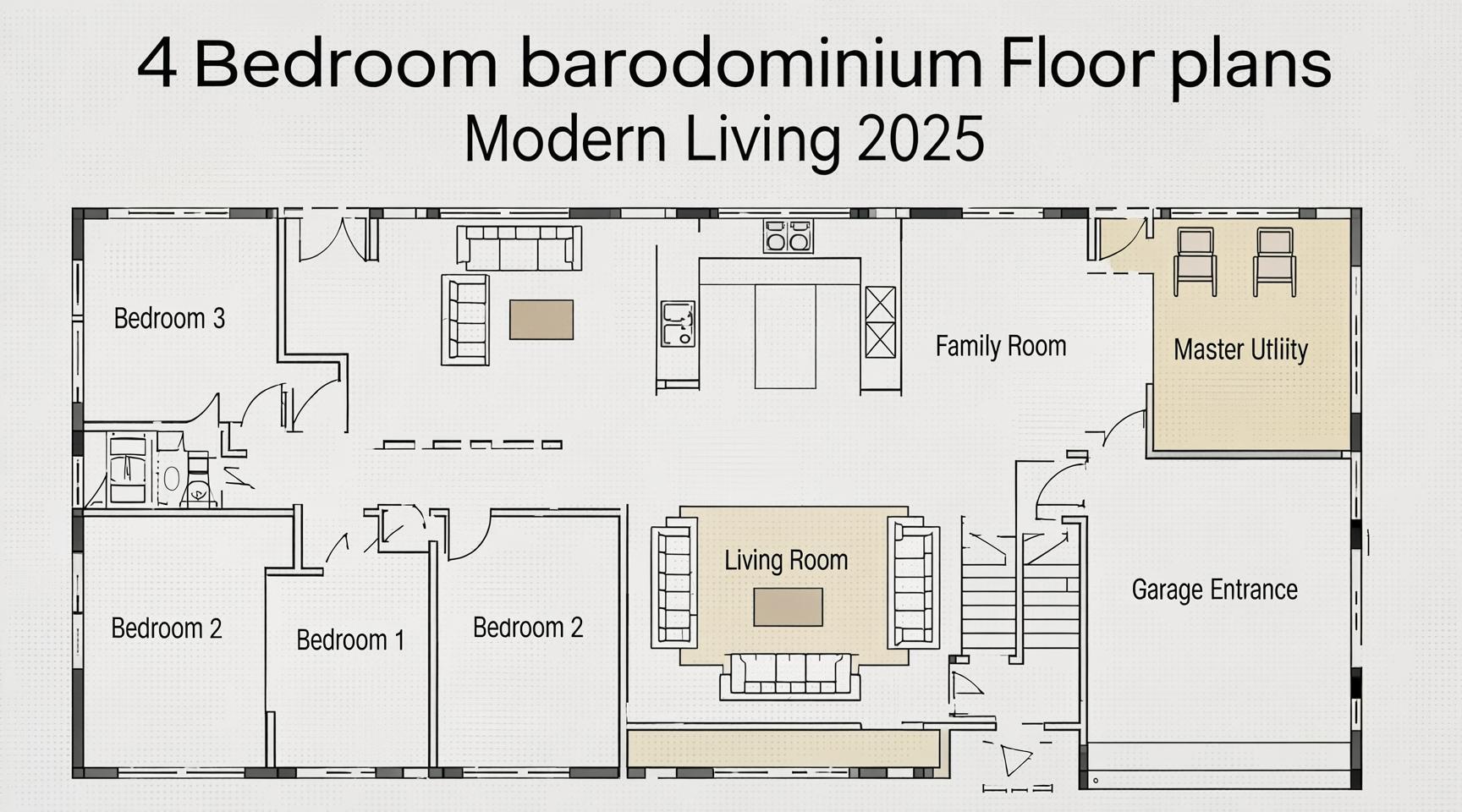
In this layout, the living room acts as the base of the horseshoe, with bedrooms flanking either side. The kitchen and dining area often sit centrally, backing onto the living space. This layout is highly symmetrical and pleasing to the eye. It works well for square or nearly square footprints. However, it requires careful HVAC design to ensure even heating and cooling reaches all corners of the horseshoe.
The “Linear” Layout
Perfect for long, narrow lots, the linear layout arranges rooms in a sequence. One might enter into the living room, pass through the dining and kitchen, and find the bedrooms in a hallway extending to the rear or side. This is a functional design but can result in a “bowling alley” feel if the living room is not wide enough. To counter this, many linear plans use dormers or skylights to bring light into the middle sections of the home.
Flow and Traffic Patterns in Open Spaces
A critical aspect of living room design in these structures is traffic flow. Because there are few walls to stop movement, paths can become undefined. A well-designed floor plan anticipates the natural walking paths. For example, the path from the garage entrance to the kitchen should not cut through the middle of a conversation circle in the living room.
Placement of the staircase is another consideration for multi-level plans. A staircase in the center of the living room can act as a natural room divider, separating the TV area from the dining space. Placing it against a wall preserves open floor space but may make the room feel lopsided. Industry experts often recommend centrally located stairs with open risers to maintain sightlines.
Materiality and Aesthetic Integration
The aesthetic of the living room in a barndominium is often defined by the juxtaposition of industrial and organic materials. The interior walls are typically framed with wood or metal studs and finished with drywall, but many owners choose to leave elements exposed. Exposed HVAC ductwork, painted black, can lend an industrial chic vibe to the living room ceiling. Conversely, wrapping structural columns in reclaimed barn wood softens the look and ties the interior back to the exterior design.
Flooring choices in the living area are critical. Polished concrete is a popular choice for its thermal mass properties (helping regulate temperature) and durability. However, it can be hard on the feet and cold without radiant heating. Many 4 bedroom barndominium floor plans opt for luxury vinyl plank (LVP) or engineered hardwood in the living zones for warmth and acoustic dampening, transitioning to tile in the kitchen and bathrooms.
Cost Efficiency and Structural Benefits
One of the driving forces behind the popularity of these plans is economic efficiency. The post-frame construction method is generally faster and requires less labor than traditional stick framing. The exterior shell can often be dried in (made weather-tight) in a matter of days. This speed allows owners to move on to the interior finishing phase sooner, reducing carrying costs.
Furthermore, the durability of metal siding and roofing results in lower maintenance costs over the lifespan of the home. This is a significant consideration for families investing in a 4-bedroom property, as it frees up budget for interior finishes and living room furnishings. The energy efficiency of a well-insulated barndominium shell also contributes to lower utility bills, a major selling point in the current economic climate.
Customization and Future-Proofing
Life changes, and a home must be able to adapt. The flexible nature of 4 bedroom barndominium floor plans allows for future modifications. Because interior walls are non-load-bearing, a bedroom can easily be converted into a home office, a gym, or a nursery as family dynamics shift. The living room, if designed with ample space, can accommodate different furniture configurations over time.
Future-proofing also involves considering accessibility. Even if a family does not currently need accessible features, planning for zero-entry showers and wider doorways during the design phase is wise. The open nature of the barndominium floor plan naturally lends itself to wheelchair accessibility, as there are fewer tight corners and hallways to navigate compared to traditional homes.
Frequently Asked Questions
How much does it cost to build a 4 bedroom barndominium?
Costs vary significantly by location and finish level, but industry averages suggest a range of $100 to $150 per square foot for the finished living space. A 4-bedroom plan typically requires 2,000 to 3,000 square feet.
Can a barndominium have a basement?
Yes, but it is less common due to the soil pressure on the large wall spans. If a basement is desired, it requires a reinforced concrete foundation that can support the heavy posts of the structure.
Are barndominiums safe in storms?
Post-frame construction is incredibly robust. The heavy timber posts and engineered trusses are designed to withstand high winds and heavy snow loads, often exceeding the safety ratings of standard residential construction.
How do you heat and cool a large barndominium living room?
Zoned HVAC systems are standard. Mini-split systems are popular for their efficiency and ability to control temperatures in specific zones, like the living room versus the bedrooms, independently.
Do barndominiums hold their value?
As demand for unique, energy-efficient homes rises, barndominiums are seeing strong resale values. The key factor is the quality of the interior finish and the location of the property.
Can I get a mortgage for a barndominium?
Yes, but it may require a specialized lender. Standard conventional loans sometimes struggle to appraise barndominiums due to a lack of comparable sales in the area, but construction loans are readily available.
What is the minimum width for a 4 bedroom barndominium?
A width of 40 to 50 feet is generally recommended to comfortably accommodate a spacious living room, a dining area, and a hallway to the bedrooms without feeling cramped.
Conclusion
Designing a home is a journey of balancing dreams with practicalities. 4 bedroom barndominium floor plans offer a compelling solution for those seeking a home that is as durable as it is beautiful. By leveraging the structural advantages of post-frame construction, these plans unlock the potential for a living room that is truly the heart of the home—vast, open, and filled with light. The strategic placement of four bedrooms ensures that while the family gathers in the communal warmth of the great room, private retreats remain just a few steps away.
Whether for a growing family or a multi-generational household, the barndominium provides a versatile framework that adapts to modern living needs. The combination of cost efficiency, low maintenance, and limitless design possibilities makes this architectural style a lasting trend in residential design. With the right floor plan, a barndominium is not just a place to sleep; it is a space to live, breathe, and grow for generations to come.