
Introduction
The quest for a perfect night’s sleep often culminates in a single, critical decision: choosing the right mattress. With the evolution of sleep technology, the market has narrowed down to two dominant contenders vying for the title of the ultimate sleep surface. The debate of Memory Foam vs Hybrid Mattresses is central to modern home bedroom design and personal health. While both promise restorative rest, they achieve it through vastly different mechanisms, construction philosophies, and material properties.
For the intermediate consumer or those looking to upgrade their sleep setup, understanding the nuances between these two types is essential. Memory foam, once a NASA innovation, revolutionized the industry with its contouring pressure relief. Hybrids, on the other hand, attempt to bridge the gap between traditional innerspring support and modern foam comfort. The choice is not merely about preference; it is about matching specific sleep styles, body types, and thermal needs to the correct architecture.
This article provides a comprehensive analysis of these two mattress titans. We will dissect their internal structures, evaluate their performance in key categories like motion isolation and temperature regulation, and provide a detailed framework to help you decide which solution is the superior investment for your home bedroom.
Table of Contents
- The Construction and Architecture of Memory Foam
- The Engineering Behind Hybrid Mattresses
- Detailed Comparison: Memory Foam vs Hybrid Mattresses
- Support and Spinal Alignment Analysis
- Temperature Regulation and Cooling Properties
- Motion Isolation and Partner Disturbance
- Durability and Long-Term Value
- Price Point and Investment Considerations
- Frequently Asked Questions
- Conclusion
The Construction and Architecture of Memory Foam
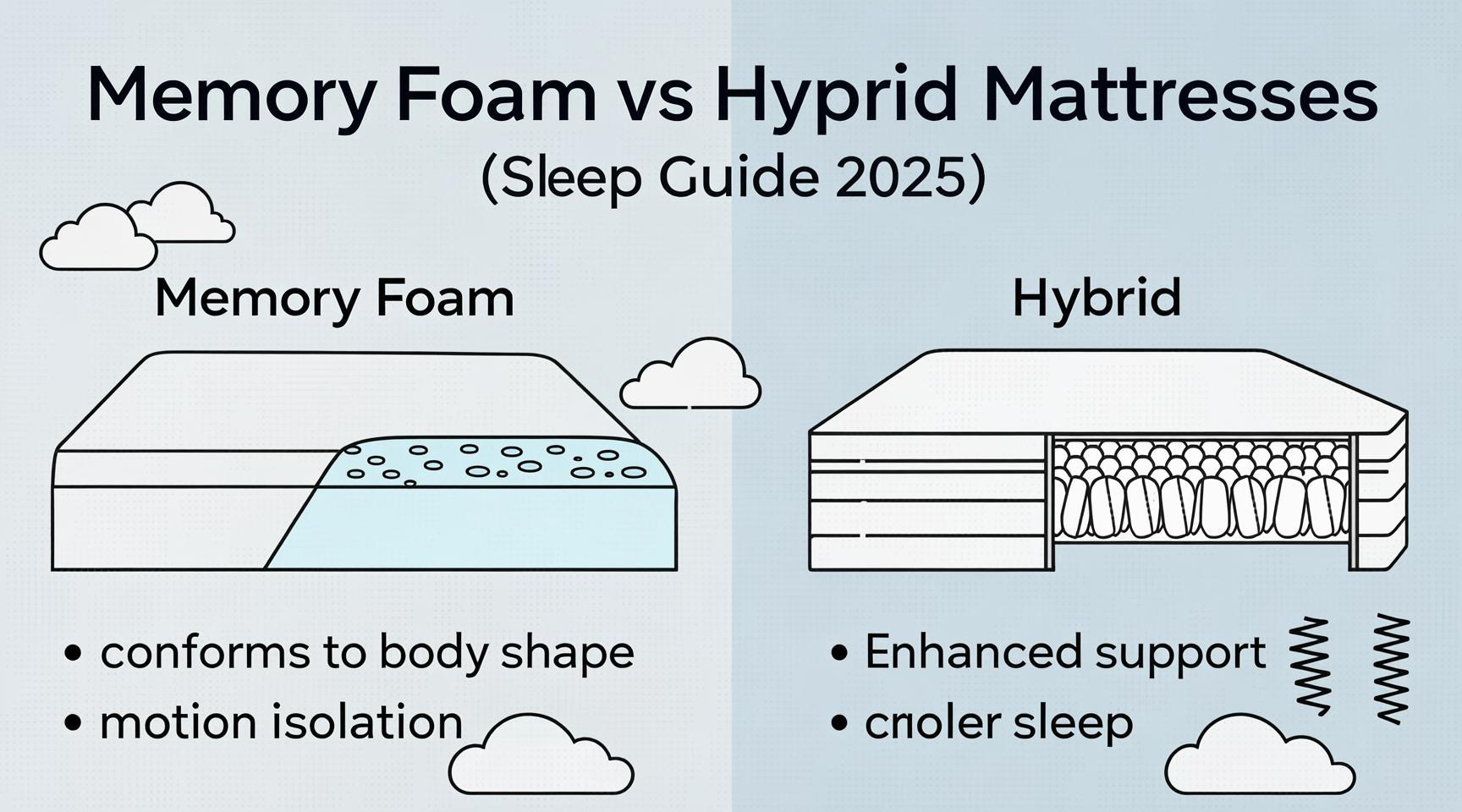
To truly grasp the differences in the Memory Foam vs Hybrid Mattresses debate, one must look beneath the surface. Memory foam mattresses are constructed entirely of foam layers, devoid of any metal coils. The primary material is viscoelastic polyurethane foam, engineered to respond to heat and pressure. This allows the material to mold precisely to the sleeper’s body, distributing weight evenly across the surface.
A typical memory foam mattress consists of three primary layers. The top layer is the comfort layer, usually one to three inches of softer foam designed to provide the initial “hug” and pressure relief. Beneath this lies the transition layer, often made of slightly denser foam, which acts as a buffer between the soft top and the rigid base. The bottom layer, known as the support core or base foam, is a high-density polyfoam that provides the structural integrity of the mattress. This all-foam build is what gives memory foam its distinct “sink-in” sensation.
Types of Memory Foam
Not all memory foam is created equal. Industry trends highlight three main variations. Traditional memory foam offers the classic contouring feel but is known to retain heat. Open-cell memory foam incorporates tiny pockets to improve airflow, addressing the heat issue. Finally, gel-infused memory foam embeds gel beads or swirls to dissipate heat more effectively. When analyzing Memory Foam vs Hybrid Mattresses, it is crucial to check which type of foam is utilized, as this significantly impacts cooling performance.
The Engineering Behind Hybrid Mattresses
Hybrid mattresses represent a fusion of old and new technologies. They are designed to offer the “best of both worlds” by combining the support of an innerspring coil system with the comfort of foam or latex layers. A true hybrid must have a significant coil support core—typically at least 3 to 4 inches in height—topped with substantial comfort layers. This distinguishes them from standard innerspring mattresses which often have thin pillow tops.
The support core of a hybrid utilizes pocketed coils. Unlike interconnected coils found in traditional spring mattresses, pocketed coils are individually wrapped in fabric. This allows each spring to move independently, providing targeted support and reducing motion transfer. Above the coils, hybrids feature comfort layers of memory foam, polyfoam, or latex. The thickness and density of these top layers determine the firmness level and the degree of contouring.
The Role of the Coil Gauge
In the hybrid construction, the gauge (thickness) of the wire used in the coils determines the support level. Lower gauge numbers indicate thicker, firmer wires, offering robust support for heavier sleepers. Higher gauge numbers mean thinner, more flexible wires, providing a plusher feel. This complexity adds a layer of customization in the Memory Foam vs Hybrid Mattresses comparison, allowing hybrids to cater to a wider range of body types and support needs.
Detailed Comparison: Memory Foam vs Hybrid Mattresses
When weighing your options, a side-by-side evaluation of key performance metrics is indispensable. The following table breaks down how these two mattress types stack up against each other in critical categories relevant to home bedroom comfort.
| Feature | Memory Foam Mattress | Hybrid Mattress |
|---|---|---|
| Construction | All-foam layers (Viscoelastic + Base Foam). | Coil support core + Foam/Latex comfort layers. |
| Feel & Contouring | Deep contouring, “sinking in” sensation, slow response. | More responsive, “on top” feel, moderate contouring. |
| Motion Isolation | Excellent – absorbs movement effectively; ideal for couples. | Good to Very Good – pocketed coils reduce transfer, but foam is superior. |
| Temperature Regulation | Potential for heat retention; gel/open-cell helps. | Superior airflow through coils; generally sleeps cooler. |
| Support & Edge Support | Even support but edge support can be weak (sitting edge). | Strong core support; reinforced edges often standard. |
| Noise Level | Silent – no moving parts. | Very low – modern coils are quiet, but occasional creaks possible over time. |
| Durability | 6-8 years on average; prone to sagging/body impressions. | 7-10 years; coils maintain structural integrity longer. |
Support and Spinal Alignment Analysis
Support is the ability of a mattress to keep the spine in a neutral alignment. In the context of Memory Foam vs Hybrid Mattresses, the mechanisms differ. Memory foam works by displacing weight. When you lie down, the foam compresses under heavier areas (hips and shoulders) while remaining supportive under lighter areas. This creates a cradling effect that is highly effective for pressure point relief, particularly for side sleepers who experience pressure buildup at the shoulder and hip.
Hybrids, conversely, offer a more buoyant support. The coil system pushes back against the body, providing a firmer foundation. This is often preferred by stomach sleepers and back sleepers who need to prevent their hips from sinking too deeply, which can cause lumbar strain. The zoned support systems often found in hybrids—where coils are firmer in the center and softer at the head and foot—are particularly effective for spinal alignment across different sleep positions.
Edge Support Considerations
Edge support is often overlooked but vital for maximizing usable sleep space. Memory foam mattresses typically have weaker edges because the foam compresses under concentrated weight. This can make the bed feel smaller. Hybrids generally feature reinforced perimeters using stiffer coils or foam encasements. If you sit on the edge of the bed to dress or if you sleep near the edge, a hybrid usually offers a more stable and secure feeling.
Temperature Regulation and Cooling Properties
One of the most frequent complaints regarding all-foam beds is heat retention. The dense structure of viscoelastic foam can trap body heat, leading to uncomfortable “sleeping hot.” While manufacturers have introduced cooling technologies like copper infusions, phase-change materials, and convoluted egg-crate designs to mitigate this, it remains a consideration in the Memory Foam vs Hybrid Mattresses comparison.
Hybrids inherently sleep cooler due to the open structure of the coil system. Air circulates freely between the springs, dissipating heat and moisture away from the body. For hot sleepers or those living in warmer climates, a hybrid is almost always the superior choice. The breathability of the coil layer provides a distinct thermal advantage that foam layers alone struggle to match without significant technological intervention.
Motion Isolation and Partner Disturbance
For couples, motion isolation is a deal-breaker. If one partner tosses and turns, the other should not be disturbed. Memory foam is the gold standard in this category. Because it is a solid block of foam with no interconnected parts, energy is absorbed locally. A movement on one side of the bed does not ripple across to the other. This “dead” feel is exactly what light sleepers crave.
Hybrids have improved significantly in this regard thanks to pocketed coils. Since the coils move independently, motion transfer is minimized compared to old-fashioned springs. However, it is not entirely eliminated. A significant movement can still create a slight disturbance. While high-end hybrids approach the motion isolation levels of foam, purists seeking zero transfer usually lean toward the all-foam option.
Durability and Long-Term Value
A mattress is a long-term investment for any home bedroom. Durability is where hybrids often pull ahead in the Memory Foam vs Hybrid Mattresses lifecycle analysis. High-density foam can degrade over time, developing permanent body impressions or softening excessively. Once foam loses its resilience, there is no fixing it.
The steel coil systems in hybrids are incredibly resilient. They maintain their shape and support level for years. While the foam comfort layers on top may eventually compress, the core remains sound. Consequently, hybrids often have a longer functional lifespan. However, hybrids are also heavier and harder to move, which can be a consideration if you relocate frequently.
Price Point and Investment Considerations
Generally, memory foam mattresses are more affordable to manufacture and ship. They can be compressed into a box efficiently, reducing logistics costs. This savings is often passed to the consumer. For budget-conscious shoppers, entry-level memory foam provides excellent value.
Hybrids are typically more expensive due to the complexity of their construction and the materials used. However, the price gap is narrowing. When evaluating value, consider the cost per year of use. A cheaper memory foam mattress that needs replacing in 6 years might cost the same annually as a durable hybrid that lasts 10 years.
Frequently Asked Questions
Which is better for side sleepers?
Side sleepers often prefer memory foam because it allows the shoulders and hips to sink in, aligning the spine and reducing pressure points. However, softer hybrids can also work well.
Which is better for back pain?
It depends on the cause. Memory foam offers contouring support that helps with pressure relief. Hybrids offer firmer support that prevents sinkage, which is better for keeping the spine aligned for back and stomach sleepers.
Do hybrid mattresses need a box spring?
No, modern hybrids do not require a traditional box spring. They perform best on a solid foundation, a slatted base (with slats no more than 3 inches apart), or an adjustable base.
Can you flip a memory foam mattress?
Most modern memory foam and hybrid mattresses are one-sided and should not be flipped. They are designed with specific comfort layers on top. Rotating the mattress head-to-foot every few months is recommended to promote even wear.
Why do memory foam mattresses smell?
New memory foam mattresses often emit a smell known as “off-gassing,” caused by the breakdown of volatile organic compounds (VOCs) packed in the plastic. It is harmless and usually dissipates within a few hours to days.
Are hybrids heavier than memory foam?
Yes, due to the steel coil system, hybrids are generally heavier than their all-foam counterparts. This makes moving them or changing sheets a more labor-intensive task.
Which mattress type is better for adjustable beds?
Memory foam is generally more flexible and bends easily on adjustable bases. However, hybrids with thinner coil gauges are also compatible and perform well on adjustable foundations.
Conclusion
The decision in the Memory Foam vs Hybrid Mattresses comparison ultimately rests on prioritizing personal sleep needs. If you crave deep pressure relief, require absolute motion isolation for a partner, and enjoy a “hugging” sensation, memory foam remains an excellent, cost-effective choice. It is the preferred surface for side sleepers and those with pressure point issues.
However, if you prioritize a cooler sleep environment, desire a more responsive and bouncy surface, or need robust edge support and longevity, the hybrid mattress is the superior option. It offers a balanced sleep experience that appeals to the widest range of body types and sleep positions. By analyzing your specific comfort requirements against the technical strengths of each, you can transform your home bedroom into a sanctuary tailored for perfect rest.



![look what mom found: 12 Smart Office Finds [2026 Guide]](https://contractorswarehouse.org/wp-content/uploads/2026/03/2033836504639344640-300x167.jpg)
![lookwhatmomfound giveaways: 10 Builder Wins [2026 Guide]](https://contractorswarehouse.org/wp-content/uploads/2026/03/2033866803544854528-300x167.jpg)